Track hundreds of satellites in dozens of windows with LogSat Professional.
About LogSat Professional for Windows
LogSat Professional for Windows is the ultimate choice of satellite tracking software for the serious
hobbyist. LogSat Professional v5.2 is a revolutionary satellite tracking program running under the Windows operating system.
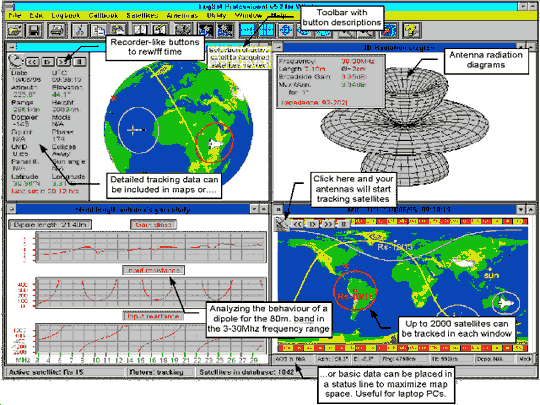
It can track up to 2000 satellites in one window, and several windows can be open at once, each independent from the others!
LogSat features independent windows. One window can track a
group of satellite, another window can show the radiation
diagram of an antenna, etc.
If
your PC has a sound card, you will be told when a satellite enters acquisition,
including its bearing. There are several other occasions where LogSat will talk to you. Some utilities useful for ham radio
operators are included. Among these is the possibility to display 3D radiation diagrams for antennas, graphs on ground wave
propagation, logbook manager, locator converter and more.
Support for The Satellite Encyclopedia. With one click you obtain detailed information (launch date, frequencies, specs, etc.)
on the selected satellite.
Everything is multitasking. You can track satellites and print out satellite schedules while working on
the DX cluster or writing a letter.
An unlimited (memory allowing...) number of satellite windows can be opened at the same time. Each window is independent from the
others.
Click on any track with the mouse and it will be highlighted, with tracking data for that satellite appearing in the
left portion of the window.
Five different map projections are available (Mercator, Equidistant, sinusoidal, Hammer, Orthographic).
Text tracking windows with fonts that auto-scale according to the window's size are available. Put it in a corner on
your screen while you're doing packet radio to see with a glance what the sat situation is.
Alarms. When ANY satellite in ANY window becomes visible, the user will be warned with voice messages. A personalized message can be
recorded for specific satellites.
Interactive sound tracking and response.
Each window can be assigned a time and a date independently from the other windows.
The tracking data includes: azimuth, elevation, range, height, squint angle, mode,
doppler effect, phase, UMD, eclipse, solar panel illumination factor, sun angle,
orbit number, solar elevation, sub-satellite points, latitude and longitude, next
AOS (or LOS), and the duration of acquisition on the next pass. Single and multi
satellite schedules, including mutual passes previsions, can be printed.
The maps can be ‘traveled’ with the mouse: the coordinates, locator, azimuth and
distance from you home position to the point under the mouse cursor appear in a
popup window.
The Keplerian elements can be easily updated with NASA or AMSAT style file formats.
With just a mouse click decide to leave thick or thin satellite trails, place sun
terminators, color fill maps, select map colors, line styles and more.
Preferences can be set either globally or separatly for each window.
Both high and low resolution maps are available,for use with faster 486DX2 and
Penthium Pcs or slower 386s.
World time zones can be displayed on maps allowing you to know with a glance who’s
awake and who’s sleeping.
An extremely easy and practical to use logbook manager for HAM radio operators. The
country beeing connected can be shown on a map, and the antenna be automatically
pointed.
The logbook can be linked with a callbook.
A very simple to use locator to lat and longitude (and vice versa) converter.
Retrieves the exact time by connecting with your modem to the USNO.
Both normal and math coprocessor versions of the program are included.
Resources To Enhance Your LogSat Professional Experience
Top ^
Learn more about satellites.
Our tutorial brings you up to speed on satellites and their uses.
Learn the answers to questions such as "What equipment do I need?" and "What can I do with satellites?". The tutorial also provides
information on the uplink/downlink frequencies for amateur satellites.Additional information about satellites is available from
The Satellite Encyclopedia. (external link)
Links to Ham, satellite-specific and weather-image websites
allow you to easily go to AMSAT's home page or to track a satellite in real time here on the Web.
Information on the Shuttle and SAREX mission is available, along with links to other Ham and weather image home pages.
Keplerian elements
educational information answers questions such as, "How often should I update Keps?" and "How do I update
Keps with LogSat?" In addition, Keps for several categories of satellites are available to download. Are you interested in EME?
Here you will also find pseudo-Keps for the Moon.
Solar data monitoring and forecasting
are available from the Space Environment Center. This includes up-to-date solar cycle predictions,
geophysical A and K indices, daily solar data, HF radio propagation reports, outlook of 10.7 cm flux, Ap, and
Kp.











 for Windows
 If
your PC has a sound card, you will be
If
your PC has a sound card, you will be